# Magic123: One Image to High-Quality 3D Object Generation Using Both 2D and 3D Diffusion Priors
[arXiv](https://arxiv.org/abs/2306.17843) | [webpage](https://guochengqian.github.io/project/magic123/)
 [Guocheng Qian](https://guochengqian.github.io/) 1,2, [Jinjie Mai](https://cemse.kaust.edu.sa/people/person/jinjie-mai) 1, [Abdullah Hamdi](https://abdullahamdi.com/) 3, [Jian Ren](https://alanspike.github.io/) 2, [Aliaksandr Siarohin](https://aliaksandrsiarohin.github.io/aliaksandr-siarohin-website/) 2, [Bing Li](https://cemse.kaust.edu.sa/people/person/bing-li) 1, [Hsin-Ying Lee](http://hsinyinglee.com/) 2, [Ivan Skorokhodov](https://universome.github.io/) 1,2, [Peter Wonka](https://peterwonka.net/) 1, [Sergey Tulyakov](http://www.stulyakov.com/) 2, [Bernard Ghanem](https://www.bernardghanem.com/) 1
1 [King Abdullah University of Science and Technology (KAUST)](https://www.kaust.edu.sa/),
2 [Snap Inc.](https://www.snap.com/),
3 [Visual Geometry Group, University of Oxford](http://www.robots.ox.ac.uk/~vgg/)
Training convergence of a demo example:
[Guocheng Qian](https://guochengqian.github.io/) 1,2, [Jinjie Mai](https://cemse.kaust.edu.sa/people/person/jinjie-mai) 1, [Abdullah Hamdi](https://abdullahamdi.com/) 3, [Jian Ren](https://alanspike.github.io/) 2, [Aliaksandr Siarohin](https://aliaksandrsiarohin.github.io/aliaksandr-siarohin-website/) 2, [Bing Li](https://cemse.kaust.edu.sa/people/person/bing-li) 1, [Hsin-Ying Lee](http://hsinyinglee.com/) 2, [Ivan Skorokhodov](https://universome.github.io/) 1,2, [Peter Wonka](https://peterwonka.net/) 1, [Sergey Tulyakov](http://www.stulyakov.com/) 2, [Bernard Ghanem](https://www.bernardghanem.com/) 1
1 [King Abdullah University of Science and Technology (KAUST)](https://www.kaust.edu.sa/),
2 [Snap Inc.](https://www.snap.com/),
3 [Visual Geometry Group, University of Oxford](http://www.robots.ox.ac.uk/~vgg/)
Training convergence of a demo example:
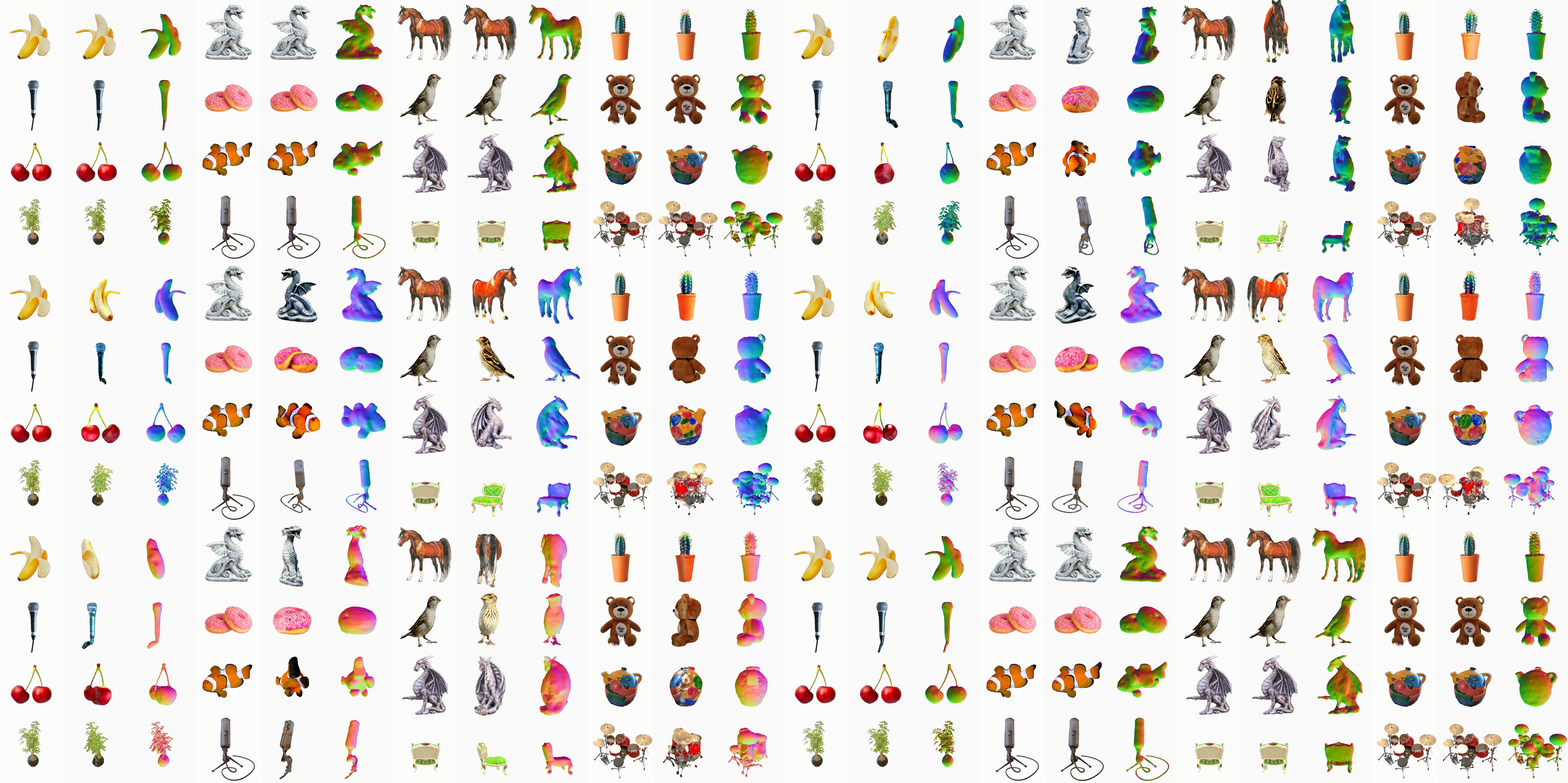
 Compare Magic123 with using only 2D prior (SDS) or using only 3D prior (Zero123):
https://github.com/guochengqian/Magic123/assets/48788073/e5a3c3cb-bcb1-4b10-8bfb-2c2eb79a9289
Official PyTorch Implementation of Magic123: One Image to High-Quality 3D Object Generation Using Both 2D and 3D Diffusion Priors. Code is built upon [Stable-DreamFusion](https://github.com/ashawkey/stable-dreamfusion) repo.
# NEWS:
- [2023/07/25] Code is available at [GitHub](https://github.com/guochengqian/Magic123)
- [2023/07/03] Paper is available at [arXiv](https://arxiv.org/abs/2306.17843)
- [2023/06/25] Much better performance than the submitted version is achieved by 1)reimplementing Magic123 using [Stable DreamFusion code](https://github.com/ashawkey/stable-dreamfusion), 2)fixing some gradient issues, 3)leveraging the [tricks](#tips-and-tricks)
- [2023] Initial version of Magic123 submitted to conference
# Install
### Install Environment
```bash
source install.sh
```
### Download pre-trained models
* [Zero-1-to-3](https://github.com/cvlab-columbia/zero123) for 3D diffusion prior.
We use `105000.ckpt` by default, reimplementation borrowed from Stable Diffusion repo, and is available in `guidance/zero123_utils.py`.
```bash
cd pretrained/zero123
wget https://huggingface.co/cvlab/zero123-weights/resolve/main/105000.ckpt
cd .../../
```
* [MiDaS](https://github.com/isl-org/MiDaS) for depth estimation.
We use `dpt_beit_large_512.pt`. Put it in folder `pretrained/midas/`
```bash
mkdir -p pretrained/midas
cd pretrained/midas
wget https://github.com/isl-org/MiDaS/releases/download/v3_1/dpt_beit_large_512.pt
cd ../../
```
# Usage
## Preprocess [Optional]
We have included all preprocessed files in `./data` directory. Preprocessing is only necessary if you want to test on your own examples.
### Step1: Extract depth
```
python preprocess_image.py --path /path/to/image
```
### Step 2: Textural inversion [Optional]
Magic123 uses the defualt [textural inversion](https://huggingface.co/docs/diffusers/training/text_inversion) from diffuers, which consumes around 2.5 hours on a 32G V100. If you do not want to spend time in this textural inversion, you can: (1) study whether there is other faster textural inversion; or (2) do not use textural inversion in the loss of texture and shape consistencies. To run textural inversion:
```
bash scripts/texural_inversion/textural_inversion.sh $GPU_IDX runwayml/stable-diffusion-v1-5 /path/to/example/rgba.png /path/to/save $token_name $init_token --max_train_steps 5000
```
$token_name is a the special token, usually name that by _examplename_
$init_token is a single token to describe the image using natural language
For example:
```bash
bash scripts/texural_inversion/textural_inversion.sh runwayml/stable-diffusion-v1-5 data/demo/ironman/rgba.png out/textual_inversion/ironman _ironman_ ironman --max_train_steps 3000
```
Don't forget to move the final `learned_embeds.bin` under data/demo/ironman/
## Run
### Run Magic123 for a single example
Takes ~40 mins for the coarse stage and ~20 mins for the second stage on a 32G V100.
```bash
bash scripts/magic123/run_both_priors.sh $GPU_NO $JOBNAME_First_Stage $JOBNAME_Second_Stage $PATH_to_Example_Directory $IMAGE_BASE_NAME $Enable_First_Stage $Enable_Second_Stage {More_Arugments}
```
As an example, run Magic123 in the dragon example using both stages in GPU 0 and set the jobname for the first stage as `default` and the jobname for the second stage as `dmtet`, by the following command:
```bash
bash scripts/magic123/run_both_priors.sh 0 default dmtet data/realfusion15/metal_dragon_statue rgba.png 1 1
```
More arguments (e.g. `--lambda_guidance 1 40`) can be appended to the command line such as:
```bash
bash scripts/magic123/run_both_priors.sh 0 default dmtet data/realfusion15/metal_dragon_statue rgba.png 1 1 --lambda_guidance 1 40
```
### Run Magic123 for a group of examples
- Run all examples in a folder, check the scripts `scripts/magic123/run_folder_both_priors.sh`
- Run all examples in a given list, check the scripts `scripts/magic123/run_list_both_priors.sh`
### Run Magic123 on a single example without textural inversion
Textural inversion is tedious (requires ~2.5 hours optimization), if you want to test Magic123 quickly on your own example without texural inversion (might degrade the performance), try the following:
- first, foreground and depth estimation
```
python preprocess_image.py --path data/demo/ironman/ironman.png
```
- Run Magic123 coarse stage without textural inversion, takes ~40 mins
```
export RUN_ID='default-a-full-body-ironman'
export DATA_DIR='data/demo/ironman'
export IMAGE_NAME='rgba.png'
export FILENAME=$(basename $DATA_DIR)
export dataset=$(basename $(dirname $DATA_DIR))
CUDA_VISIBLE_DEVICES=0 python main.py -O \
--text "A high-resolution DSLR image of a full body ironman" \
--sd_version 1.5 \
--image ${DATA_DIR}/${IMAGE_NAME} \
--workspace out/magic123-${RUN_ID}-coarse/$dataset/magic123_${FILENAME}_${RUN_ID}_coarse \
--optim adam \
--iters 5000 \
--guidance SD zero123 \
--lambda_guidance 1.0 40 \
--guidance_scale 100 5 \
--latent_iter_ratio 0 \
--normal_iter_ratio 0.2 \
--t_range 0.2 0.6 \
--bg_radius -1 \
--save_mesh
```
- Run Magic123 fine stage without textural inversion, takes around ~20 mins
```
export RUN_ID='default-a-full-body-ironman'
export RUN_ID2='dmtet'
export DATA_DIR='data/demo/ironman'
export IMAGE_NAME='rgba.png'
export FILENAME=$(basename $DATA_DIR)
export dataset=$(basename $(dirname $DATA_DIR))
CUDA_VISIBLE_DEVICES=0 python main.py -O \
--text "A high-resolution DSLR image of a full body ironman" \
--sd_version 1.5 \
--image ${DATA_DIR}/${IMAGE_NAME} \
--workspace out/magic123-${RUN_ID}-${RUN_ID2}/$dataset/magic123_${FILENAME}_${RUN_ID}_${RUN_ID2} \
--dmtet --init_ckpt out/magic123-${RUN_ID}-coarse/$dataset/magic123_${FILENAME}_${RUN_ID}_coarse/checkpoints/magic123_${FILENAME}_${RUN_ID}_coarse.pth \
--iters 5000 \
--optim adam \
--known_view_interval 4 \
--latent_iter_ratio 0 \
--guidance SD zero123 \
--lambda_guidance 1e-3 0.01 \
--guidance_scale 100 5 \
--rm_edge \
--bg_radius -1 \
--save_mesh
```
### Run ablation studies
- Run Magic123 with only 2D prior *with* textural inversion (Like RealFusion but we achieve much better performance through training stragies and the coarse-to-fine pipeline)
```
bash scripts/magic123/run_2dprior.sh 0 default dmtet data/realfusion15/metal_dragon_statue rgba.png 1 1
```
- Run Magic123 with only 2D prior *without* textural inversion (Like RealFusion but we achieve much better performance through training stragies and the coarse-to-fine pipeline)
```
bash scripts/magic123/run_2dprior_notextinv_ironman.sh 0 default 1 1
```
note: change the path and the text prompt inside the script if you wana test another example.
- Run Magic123 with only 3D prior (Like Zero-1-to-3 but we achieve much better performance through training stragies and the coarse-to-fine pipeline)
```
bash scripts/magic123/run_3dprior.sh 0 default dmtet data/demo/ironman rgba.png 1 1
```
# Tips and Tricks
1. Fix camera distance (*radius_range*) and FOV (*fovy_range*) and tune the camera polar range (*theta_range*). Note it is better to keep camera jittering to reduce grid artifacts.
2. Smaller range of time steps for the defusion noise (t_range). We find *[0.2, 0.6]* gives better performance for image-to-3D tasks.
3. Using normals as latent in the first 2000 improves generated geometry a bit gernerally (but not always). We turn on this for Magic123 corase stage in the script `--normal_iter_ratio 0.2`
4. We erode segmentation edges (makes the segmentation map 2 pixels shrinked towards internal side) to remove artifacts due to segmentation erros. This is turned on in the fine stage in magic123 in the script through `--rm_edge`
5. Other general tricks such as improved texural inversion, advanced diffusion prior (DeepFloyd, SD-XL), stronger 3D prior (Zero123-XL), and larger batch size can be adopted as well but not studied in this work.
# Acknowledgement
This work is build upon Stable DreamFusion, many thanks to the author [Kiui Jiaxiang Tang](https://github.com/ashawkey) and many other contributors.
* [Stable DreamFusion](https://github.com/ashawkey/stable-dreamfusion)
```
@misc{stable-dreamfusion,
Author = {Jiaxiang Tang},
Year = {2022},
Note = {https://github.com/ashawkey/stable-dreamfusion},
Title = {Stable-dreamfusion: Text-to-3D with Stable-diffusion}
}
```
We also get inspirations from a list of amazing research works and open-source projects, thanks a lot to all the authors for sharing!
* [DreamFusion: Text-to-3D using 2D Diffusion](https://dreamfusion3d.github.io/)
```
@article{poole2022dreamfusion,
author = {Poole, Ben and Jain, Ajay and Barron, Jonathan T. and Mildenhall, Ben},
title = {DreamFusion: Text-to-3D using 2D Diffusion},
journal = {arXiv},
year = {2022},
}
```
* [Magic3D: High-Resolution Text-to-3D Content Creation](https://research.nvidia.com/labs/dir/magic3d/)
```
@inproceedings{lin2023magic3d,
title={Magic3D: High-Resolution Text-to-3D Content Creation},
author={Lin, Chen-Hsuan and Gao, Jun and Tang, Luming and Takikawa, Towaki and Zeng, Xiaohui and Huang, Xun and Kreis, Karsten and Fidler, Sanja and Liu, Ming-Yu and Lin, Tsung-Yi},
booktitle={IEEE Conference on Computer Vision and Pattern Recognition ({CVPR})},
year={2023}
}
```
* [Zero-1-to-3: Zero-shot One Image to 3D Object](https://github.com/cvlab-columbia/zero123)
```
@misc{liu2023zero1to3,
title={Zero-1-to-3: Zero-shot One Image to 3D Object},
author={Ruoshi Liu and Rundi Wu and Basile Van Hoorick and Pavel Tokmakov and Sergey Zakharov and Carl Vondrick},
year={2023},
eprint={2303.11328},
archivePrefix={arXiv},
primaryClass={cs.CV}
}
```
* [RealFusion: 360° Reconstruction of Any Object from a Single Image](https://github.com/lukemelas/realfusion)
```
@inproceedings{melaskyriazi2023realfusion,
author = {Melas-Kyriazi, Luke and Rupprecht, Christian and Laina, Iro and Vedaldi, Andrea},
title = {RealFusion: 360 Reconstruction of Any Object from a Single Image},
booktitle={CVPR}
year = {2023},
url = {https://arxiv.org/abs/2302.10663},
}
```
* [Make-it-3d: High-fidelity 3d creation from a single image with diffusion prior](https://arxiv.org/abs/2303.14184)
```
@article{tang2023make-it-3d,
title={Make-it-3d: High-fidelity 3d creation from a single image with diffusion prior},
author={Tang, Junshu and Wang, Tengfei and Zhang, Bo and Zhang, Ting and Yi, Ran and Ma, Lizhuang and Chen, Dong},
journal={arXiv preprint arXiv:2303.14184},
year={2023}
}
```
* [Stable Diffusion](https://github.com/CompVis/stable-diffusion) and the [diffusers](https://github.com/huggingface/diffusers) library.
```
@misc{rombach2021highresolution,
title={High-Resolution Image Synthesis with Latent Diffusion Models},
author={Robin Rombach and Andreas Blattmann and Dominik Lorenz and Patrick Esser and Björn Ommer},
year={2021},
eprint={2112.10752},
archivePrefix={arXiv},
primaryClass={cs.CV}
}
@misc{von-platen-etal-2022-diffusers,
author = {Patrick von Platen and Suraj Patil and Anton Lozhkov and Pedro Cuenca and Nathan Lambert and Kashif Rasul and Mishig Davaadorj and Thomas Wolf},
title = {Diffusers: State-of-the-art diffusion models},
year = {2022},
publisher = {GitHub},
journal = {GitHub repository},
howpublished = {\url{https://github.com/huggingface/diffusers}}
}
```
# Cite
If you find this work useful, a citation will be appreciated via:
```
@article{qian2023magic123,
title={Magic123: One Image to High-Quality 3D Object Generation Using Both 2D and 3D Diffusion Priors},
author={Qian, Guocheng and Mai, Jinjie and Hamdi, Abdullah and Ren, Jian and Siarohin, Aliaksandr and Li, Bing and Lee, Hsin-Ying and Skorokhodov, Ivan and Wonka, Peter and Tulyakov, Sergey and others},
journal={arXiv preprint arXiv:2306.17843},
year={2023}
}
```
Compare Magic123 with using only 2D prior (SDS) or using only 3D prior (Zero123):
https://github.com/guochengqian/Magic123/assets/48788073/e5a3c3cb-bcb1-4b10-8bfb-2c2eb79a9289
Official PyTorch Implementation of Magic123: One Image to High-Quality 3D Object Generation Using Both 2D and 3D Diffusion Priors. Code is built upon [Stable-DreamFusion](https://github.com/ashawkey/stable-dreamfusion) repo.
# NEWS:
- [2023/07/25] Code is available at [GitHub](https://github.com/guochengqian/Magic123)
- [2023/07/03] Paper is available at [arXiv](https://arxiv.org/abs/2306.17843)
- [2023/06/25] Much better performance than the submitted version is achieved by 1)reimplementing Magic123 using [Stable DreamFusion code](https://github.com/ashawkey/stable-dreamfusion), 2)fixing some gradient issues, 3)leveraging the [tricks](#tips-and-tricks)
- [2023] Initial version of Magic123 submitted to conference
# Install
### Install Environment
```bash
source install.sh
```
### Download pre-trained models
* [Zero-1-to-3](https://github.com/cvlab-columbia/zero123) for 3D diffusion prior.
We use `105000.ckpt` by default, reimplementation borrowed from Stable Diffusion repo, and is available in `guidance/zero123_utils.py`.
```bash
cd pretrained/zero123
wget https://huggingface.co/cvlab/zero123-weights/resolve/main/105000.ckpt
cd .../../
```
* [MiDaS](https://github.com/isl-org/MiDaS) for depth estimation.
We use `dpt_beit_large_512.pt`. Put it in folder `pretrained/midas/`
```bash
mkdir -p pretrained/midas
cd pretrained/midas
wget https://github.com/isl-org/MiDaS/releases/download/v3_1/dpt_beit_large_512.pt
cd ../../
```
# Usage
## Preprocess [Optional]
We have included all preprocessed files in `./data` directory. Preprocessing is only necessary if you want to test on your own examples.
### Step1: Extract depth
```
python preprocess_image.py --path /path/to/image
```
### Step 2: Textural inversion [Optional]
Magic123 uses the defualt [textural inversion](https://huggingface.co/docs/diffusers/training/text_inversion) from diffuers, which consumes around 2.5 hours on a 32G V100. If you do not want to spend time in this textural inversion, you can: (1) study whether there is other faster textural inversion; or (2) do not use textural inversion in the loss of texture and shape consistencies. To run textural inversion:
```
bash scripts/texural_inversion/textural_inversion.sh $GPU_IDX runwayml/stable-diffusion-v1-5 /path/to/example/rgba.png /path/to/save $token_name $init_token --max_train_steps 5000
```
$token_name is a the special token, usually name that by _examplename_
$init_token is a single token to describe the image using natural language
For example:
```bash
bash scripts/texural_inversion/textural_inversion.sh runwayml/stable-diffusion-v1-5 data/demo/ironman/rgba.png out/textual_inversion/ironman _ironman_ ironman --max_train_steps 3000
```
Don't forget to move the final `learned_embeds.bin` under data/demo/ironman/
## Run
### Run Magic123 for a single example
Takes ~40 mins for the coarse stage and ~20 mins for the second stage on a 32G V100.
```bash
bash scripts/magic123/run_both_priors.sh $GPU_NO $JOBNAME_First_Stage $JOBNAME_Second_Stage $PATH_to_Example_Directory $IMAGE_BASE_NAME $Enable_First_Stage $Enable_Second_Stage {More_Arugments}
```
As an example, run Magic123 in the dragon example using both stages in GPU 0 and set the jobname for the first stage as `default` and the jobname for the second stage as `dmtet`, by the following command:
```bash
bash scripts/magic123/run_both_priors.sh 0 default dmtet data/realfusion15/metal_dragon_statue rgba.png 1 1
```
More arguments (e.g. `--lambda_guidance 1 40`) can be appended to the command line such as:
```bash
bash scripts/magic123/run_both_priors.sh 0 default dmtet data/realfusion15/metal_dragon_statue rgba.png 1 1 --lambda_guidance 1 40
```
### Run Magic123 for a group of examples
- Run all examples in a folder, check the scripts `scripts/magic123/run_folder_both_priors.sh`
- Run all examples in a given list, check the scripts `scripts/magic123/run_list_both_priors.sh`
### Run Magic123 on a single example without textural inversion
Textural inversion is tedious (requires ~2.5 hours optimization), if you want to test Magic123 quickly on your own example without texural inversion (might degrade the performance), try the following:
- first, foreground and depth estimation
```
python preprocess_image.py --path data/demo/ironman/ironman.png
```
- Run Magic123 coarse stage without textural inversion, takes ~40 mins
```
export RUN_ID='default-a-full-body-ironman'
export DATA_DIR='data/demo/ironman'
export IMAGE_NAME='rgba.png'
export FILENAME=$(basename $DATA_DIR)
export dataset=$(basename $(dirname $DATA_DIR))
CUDA_VISIBLE_DEVICES=0 python main.py -O \
--text "A high-resolution DSLR image of a full body ironman" \
--sd_version 1.5 \
--image ${DATA_DIR}/${IMAGE_NAME} \
--workspace out/magic123-${RUN_ID}-coarse/$dataset/magic123_${FILENAME}_${RUN_ID}_coarse \
--optim adam \
--iters 5000 \
--guidance SD zero123 \
--lambda_guidance 1.0 40 \
--guidance_scale 100 5 \
--latent_iter_ratio 0 \
--normal_iter_ratio 0.2 \
--t_range 0.2 0.6 \
--bg_radius -1 \
--save_mesh
```
- Run Magic123 fine stage without textural inversion, takes around ~20 mins
```
export RUN_ID='default-a-full-body-ironman'
export RUN_ID2='dmtet'
export DATA_DIR='data/demo/ironman'
export IMAGE_NAME='rgba.png'
export FILENAME=$(basename $DATA_DIR)
export dataset=$(basename $(dirname $DATA_DIR))
CUDA_VISIBLE_DEVICES=0 python main.py -O \
--text "A high-resolution DSLR image of a full body ironman" \
--sd_version 1.5 \
--image ${DATA_DIR}/${IMAGE_NAME} \
--workspace out/magic123-${RUN_ID}-${RUN_ID2}/$dataset/magic123_${FILENAME}_${RUN_ID}_${RUN_ID2} \
--dmtet --init_ckpt out/magic123-${RUN_ID}-coarse/$dataset/magic123_${FILENAME}_${RUN_ID}_coarse/checkpoints/magic123_${FILENAME}_${RUN_ID}_coarse.pth \
--iters 5000 \
--optim adam \
--known_view_interval 4 \
--latent_iter_ratio 0 \
--guidance SD zero123 \
--lambda_guidance 1e-3 0.01 \
--guidance_scale 100 5 \
--rm_edge \
--bg_radius -1 \
--save_mesh
```
### Run ablation studies
- Run Magic123 with only 2D prior *with* textural inversion (Like RealFusion but we achieve much better performance through training stragies and the coarse-to-fine pipeline)
```
bash scripts/magic123/run_2dprior.sh 0 default dmtet data/realfusion15/metal_dragon_statue rgba.png 1 1
```
- Run Magic123 with only 2D prior *without* textural inversion (Like RealFusion but we achieve much better performance through training stragies and the coarse-to-fine pipeline)
```
bash scripts/magic123/run_2dprior_notextinv_ironman.sh 0 default 1 1
```
note: change the path and the text prompt inside the script if you wana test another example.
- Run Magic123 with only 3D prior (Like Zero-1-to-3 but we achieve much better performance through training stragies and the coarse-to-fine pipeline)
```
bash scripts/magic123/run_3dprior.sh 0 default dmtet data/demo/ironman rgba.png 1 1
```
# Tips and Tricks
1. Fix camera distance (*radius_range*) and FOV (*fovy_range*) and tune the camera polar range (*theta_range*). Note it is better to keep camera jittering to reduce grid artifacts.
2. Smaller range of time steps for the defusion noise (t_range). We find *[0.2, 0.6]* gives better performance for image-to-3D tasks.
3. Using normals as latent in the first 2000 improves generated geometry a bit gernerally (but not always). We turn on this for Magic123 corase stage in the script `--normal_iter_ratio 0.2`
4. We erode segmentation edges (makes the segmentation map 2 pixels shrinked towards internal side) to remove artifacts due to segmentation erros. This is turned on in the fine stage in magic123 in the script through `--rm_edge`
5. Other general tricks such as improved texural inversion, advanced diffusion prior (DeepFloyd, SD-XL), stronger 3D prior (Zero123-XL), and larger batch size can be adopted as well but not studied in this work.
# Acknowledgement
This work is build upon Stable DreamFusion, many thanks to the author [Kiui Jiaxiang Tang](https://github.com/ashawkey) and many other contributors.
* [Stable DreamFusion](https://github.com/ashawkey/stable-dreamfusion)
```
@misc{stable-dreamfusion,
Author = {Jiaxiang Tang},
Year = {2022},
Note = {https://github.com/ashawkey/stable-dreamfusion},
Title = {Stable-dreamfusion: Text-to-3D with Stable-diffusion}
}
```
We also get inspirations from a list of amazing research works and open-source projects, thanks a lot to all the authors for sharing!
* [DreamFusion: Text-to-3D using 2D Diffusion](https://dreamfusion3d.github.io/)
```
@article{poole2022dreamfusion,
author = {Poole, Ben and Jain, Ajay and Barron, Jonathan T. and Mildenhall, Ben},
title = {DreamFusion: Text-to-3D using 2D Diffusion},
journal = {arXiv},
year = {2022},
}
```
* [Magic3D: High-Resolution Text-to-3D Content Creation](https://research.nvidia.com/labs/dir/magic3d/)
```
@inproceedings{lin2023magic3d,
title={Magic3D: High-Resolution Text-to-3D Content Creation},
author={Lin, Chen-Hsuan and Gao, Jun and Tang, Luming and Takikawa, Towaki and Zeng, Xiaohui and Huang, Xun and Kreis, Karsten and Fidler, Sanja and Liu, Ming-Yu and Lin, Tsung-Yi},
booktitle={IEEE Conference on Computer Vision and Pattern Recognition ({CVPR})},
year={2023}
}
```
* [Zero-1-to-3: Zero-shot One Image to 3D Object](https://github.com/cvlab-columbia/zero123)
```
@misc{liu2023zero1to3,
title={Zero-1-to-3: Zero-shot One Image to 3D Object},
author={Ruoshi Liu and Rundi Wu and Basile Van Hoorick and Pavel Tokmakov and Sergey Zakharov and Carl Vondrick},
year={2023},
eprint={2303.11328},
archivePrefix={arXiv},
primaryClass={cs.CV}
}
```
* [RealFusion: 360° Reconstruction of Any Object from a Single Image](https://github.com/lukemelas/realfusion)
```
@inproceedings{melaskyriazi2023realfusion,
author = {Melas-Kyriazi, Luke and Rupprecht, Christian and Laina, Iro and Vedaldi, Andrea},
title = {RealFusion: 360 Reconstruction of Any Object from a Single Image},
booktitle={CVPR}
year = {2023},
url = {https://arxiv.org/abs/2302.10663},
}
```
* [Make-it-3d: High-fidelity 3d creation from a single image with diffusion prior](https://arxiv.org/abs/2303.14184)
```
@article{tang2023make-it-3d,
title={Make-it-3d: High-fidelity 3d creation from a single image with diffusion prior},
author={Tang, Junshu and Wang, Tengfei and Zhang, Bo and Zhang, Ting and Yi, Ran and Ma, Lizhuang and Chen, Dong},
journal={arXiv preprint arXiv:2303.14184},
year={2023}
}
```
* [Stable Diffusion](https://github.com/CompVis/stable-diffusion) and the [diffusers](https://github.com/huggingface/diffusers) library.
```
@misc{rombach2021highresolution,
title={High-Resolution Image Synthesis with Latent Diffusion Models},
author={Robin Rombach and Andreas Blattmann and Dominik Lorenz and Patrick Esser and Björn Ommer},
year={2021},
eprint={2112.10752},
archivePrefix={arXiv},
primaryClass={cs.CV}
}
@misc{von-platen-etal-2022-diffusers,
author = {Patrick von Platen and Suraj Patil and Anton Lozhkov and Pedro Cuenca and Nathan Lambert and Kashif Rasul and Mishig Davaadorj and Thomas Wolf},
title = {Diffusers: State-of-the-art diffusion models},
year = {2022},
publisher = {GitHub},
journal = {GitHub repository},
howpublished = {\url{https://github.com/huggingface/diffusers}}
}
```
# Cite
If you find this work useful, a citation will be appreciated via:
```
@article{qian2023magic123,
title={Magic123: One Image to High-Quality 3D Object Generation Using Both 2D and 3D Diffusion Priors},
author={Qian, Guocheng and Mai, Jinjie and Hamdi, Abdullah and Ren, Jian and Siarohin, Aliaksandr and Li, Bing and Lee, Hsin-Ying and Skorokhodov, Ivan and Wonka, Peter and Tulyakov, Sergey and others},
journal={arXiv preprint arXiv:2306.17843},
year={2023}
}
```